Fifteenkey

A place to indulge my narcissism... and write stuff...

Who Are You?

Seven and a half years ago, I wrote, “Approaching the 13th hole,” using 18 holes to demarcate one’s life. Today’s calculation has me realizing I misinterpreted the math back then, and today find myself already off the tee on the 15th, probably looking for my ball in the woods after a slice. Yeah, it can be a frustrating game just thinking about it. “They” say golf is a mental game. Actually, A quote attributed to Jack Nicklaus is, “The game of golf is 90% mental and 10% physical,” but if you think about it, every aspect of life is a mental game. Human physical, cognitive, emotional, social, and spiritual attributes are orchestrated by the brain. Of course, not everyone agrees, but let’s just go with “life is a mental game” for now.

A little over three months ago, I was retired by my former employer. I’d intended to retire at the end of 2025, so getting a six-week paid vacation as part of a severance package gave me time to think about and plan for post-retirement old-guy stuff like Social Security, Medicare, and the supplemental coverages that add up quickly. That’s a convoluted and overly complex process, but it was easy compared to the one I’m still going through. As Pete Townshend asked:

Who are you? Who, who, who, who?

Yeah, one quarter in since “the event,” I’m still in transition, peering across a blank landscape from who I was then, in search of who I am now. I think I may have been more attached to my work/professional identity than I realized. Recently, as I find myself seeking affirmation from social media, I’m curbing those impulses, especially on LinkedIn, where there’s still a psychological pull to be “relevant” and part of the conversation.

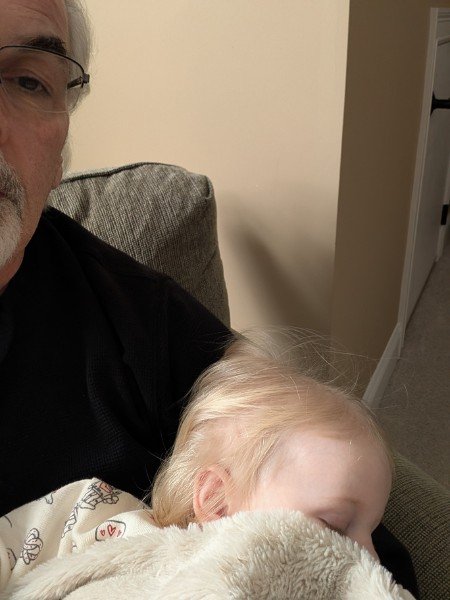
So now that my professional identity of “Director in a tech company” has been stripped like Chuck Conners’ stripes in “Branded,” well, “who the fuck are you?” Well, Pete, I guess I’ll start with father, grandfather, husband, and all-around swell guy. OK, I’ll cut that last one. My ego is damaged, so be gentle. As I write, I’m getting some ideas, particularly about teaching my children and grandchildren. Toddler Eliza enjoys hanging with her grandfather, and the feeling is mutual. With her parents both business owners, that “Manny” identity may be increasing. Wait, there’s more. Chef. Cyclist. Writer and aspiring comedian.

Retirement is a mental game and a work in progress.

Home Cooking

Bosch 800 Electric Range set up in a kitchenI love to cook and do most of the meal planning and prep for my family. Now that I’m officially retired, “going out to dinner whenever the hell we want to” has faced budgetary scrutiny. We could do it, but subconsciously, I’m holding back a bit while I get my arms around living on a fixed income. That phrase always makes me smile. Back when my dad was alive and busting balls on the golf course, he’d always go there when the post-18 bar bill arrived, “I’m on a fixed income!” As genetics would have it, that phrase is now a regular in my post-retirement lexicon. 

In the past couple of weeks, the cooking-at-home thing has run into a couple of obstacles. First, the right-front double burner of my electric range now produces heat only from the small inner burner. Second, the microwave above it suffered a sudden death over the weekend. I use it only to thaw frozen stuff, reheat leftovers, and most importantly, froth ⅓ of a cup of oat milk for each cup of coffee in the morning. Still, it is missed. Just today, I had to heat the oat milk in a saucepan and a leftover Super Bowl half a steak and cheese in a sautee pan. I appreciate the analog deceleration of life this provides, but I suspect slow cooking will get old fast.

As is my wont, I spent much of Super Sunday conducting thorough research and hands-on inspections of replacement appliances. Back in 2014, a kitchen reno brought a Whirlpool suite of appliances into my kitchen. My research found that the lifespan of major appliances is roughly 13-15 years, so we’re a tad early on the cooking units, but it doesn’t make financial sense to repair them. The fridge and dishwasher are still fully functional, so my initial research focused on Whirlpool to keep the family together, but the reviews these days aren’t great. In fact, customer opinions aren’t very good on any of the major brands. It’s a capitalism thing. Manufacturers have to improve profit margins every year, so that means cutting costs for humans and the raw materials used to build these things. So, Whirlpool… Didn’t make the cut. 

My strategy now is to settle on a new brand to replace the range and microwave, then deal with the other two when the time comes. Back to research. I’ll tell you, these AI tools rely quite a bit on Reddit threads, and what they show is overall dissatisfaction with appliance brands. Now, Bosch has always been a brand I associate with quality, so I explored it. They have a 100, 300, 500, and 800 series hierarchy, and the 800 had the best reviews and, naturally, the highest price point. The rest of the brands were largely bunched together – GE, LG, Maytag, Frigidaire, Samsung. One brand that piqued my interest and held up in reviews was GE Profile, one of several GE sub-brands. Now to get physical.

Locally, we have Best Buy, Lowe’s, and Home Depot, although I will never give the latter a dime if I can help it, mostly for political reasons, although a large corporation like Lowe’s probably splits their political contributions around to both major parties. We do have a local appliance chain, and I don’t know the owner’s political leanings, and I don’t want to. In any case, I prefer to support a local small business. On Sunday afternoon, I waded through a sea of appliances and got hands-on with some brands to see if I could “feel” a difference in quality. How do the doors open? How do they close? How do the knobs turn? Are there knobs at all? What is the build quality of fit and finish? How are the aesthetics? I want back and forth, literally walking from one unit to the next, opening, closing, feeling, looking. 

After pacing and thinking, I chose units from the Bosch 800 line and opted for the electric, smooth-top range over an induction model. I was introduced to induction cooking during a 2018 trip to Europe, when a non-iron pan just wouldn’t heat up. Yep, magnetize me. From what I now understand, a strong induction burner will boil water about 2x faster than a standard electric stovetop and is slightly more energy-efficient, but not worth the $1,300.00 premium in my opinion.

Delivery and installation will be in a week. Until then, I’ll be heating oat milk and leftovers the old-fashioned way.

End of the Line

Nearly five years ago, I wrote, “Will I cry when I retire?” On November 14, 2025, I was part of yet another “Reduction in Force” (RIF) by UKG, which kicked off the decision process. For the record, I did not cry on that day. I felt a tremendous sorrow, but it was for those who remained, and I fear it’s not going to improve, but that’s for another day. In the aftermath of the layoff, I was unsure whether I would simply retire or carry on in some capacity. I was uncertain about living without a steady paycheck, and concerned about how the loss of identity would impact my psyche and fragile male ego. For the balance of the year, I researched and made decisions on things like Social Security, healthcare, 401K’s, IRA’s, HSA’s, and other EIEIO’s. That effort was completed with facts, figures, and lots of forms. All good there. Well, I did discover that one cannot pay a “Medigap” premium with HSA funds. Oiy. I did pay for a consultant to help me with all of the financial stuff, and actually found “they” could help me with Estate Planning, migrating this blog from one hosting provider to a much cheaper one, moving from Microsoft Office to Google Workspace, stock analysis, recipes, a book outline, TV show binge recommendations, and even a “Brutal Self-Analysis & Healing Roadmap.” Yeah, Gemini Pro (AI) is worth the twenty bucks a month. 

With all of that “work” behind me, and doubt whether I’m capable of writing a book, I’m in a “now what?” period. I won’t be riding my bicycle anytime soon due to the frozen tundra, but I’m working out regularly indoors, and my daughter has me doing yoga on a weekly+ cadence, and I’ve been doing the “manny” thing a bit for my 15-month-old granddaughter. Groceries are still a big weekly highlight, plus extra time affords me space to experiment more with recipes. Last night was a new one, Pasta alla Zozzona, the “Cousin of Carbonara who Likes Red Sauce.” It was delicious, even without the guanciale. I think a pound of sausage in a recipe that called for half that was quite porky enough. Speaking of dining, my wife, son, and I have cut back (see budget, above) on restaurants to about once a week. It’s introduced a bit of novelty back into going out to eat, and we’re enjoying it. I’ve yet to receive a Social Security check, so I’m closely monitoring our budget for a few months. 

So, back to the “Will I cry when I retire” thing. No, I will not. I have decided I have no need, either financially or egotistically, to continue working for the man in any capacity. I’m done with that. Retired. There, I said it, and I’m not crying, though, as an aside, the recent passing of Catherine O’Hara has this whole household verklempt. We love our “Moira.” Actually, now I need to work out, then make dinner, then go to my daughter’s yoga class. I am going to get back here on the “Brutal Self-Analysis & Healing Roadmap.” That was enlightening.

Love or Hate?

I recently severed the remaining social media contact I had with friends and family who still support Donald Trump. I think the murder, yeah, just my opinion, of Renee Good in Minneapolis was my breaking point. There are arguments on both sides regarding the incident, but what local or state law enforcement officer would have shot a woman in the face, then two to three more times, before uttering, “fucking bitch” in a similar situation? Under the direction of Stephen Miller and Kristi Noem, ICE is terrorizing US communities for political coercion and control under the guise of “immigration enforcement.” It’s curious that they haven’t deployed ICE to red states like Texas, even though the Lone Star State has a much higher population of undocumented immigrants than the blue states where ICE has swarmed.

Back in 2020, I wrote “My Trump-supporting friends and family,” to understand how they could support a career con-man. In the years since, I culled those connections down to a few, and now they’re all gone. At least those I know of. It’s sure to be awkward if and when I see any of them in person, but I have lost all remaining respect for people who still support this idiotic, racist narcissist.

Still, I’m curious how they can still support the man. Greed, racism, and ignorance all come to mind, but based on my own in-person interaction with them, I still consider many of these people “good people.” Some of them were raised on or developed conservative values like limited government, individual liberty, free markets, and social tradition, or “moral order,” usually rooted in Judeo-Christian ethics. Given those values, how can they possibly believe Donald Trump stands for any of them now?

Yesterday, I listened to a podcast episode of the Ezra Klein Show with Yuval Levin, Director of social, cultural, and constitutional studies at the American Enterprise Institute, a prominent conservative/neoconservative think tank founded in 1938. He’s also the author of several books on policy and political theory, including “American Covenant: How the Constitution Unified Our Nation – and Could Again.”

Toward the end of the interview, Klein asked Levin about the difference between traditional conservatives and those of today. i.e. MAGA. Levin’s response nailed it:

“Now, I would say more than conservative, one way to think about the difference is about whether your politics begins from what you care about most, what you love, or whether it begins from what you fear and what you hate. To me, as a young person, conservatism was appealing and as remained appealing because it’s fundamentally rooted and begins from what we love in the world.”

“And so it seems to me that it’s incumbent upon older people on the right like myself to make the case to younger people on the right. That ultimately we win by advancing what we love in the world and by persuading the country, by persuading other Americans that they should love it too. And that understanding ourselves as being at war with our own society is not a recipe for an effective politics or a good life.

On this Martin Luther King Jr. Day, and given the vitriol on both sides politically in the US, I think it’s a constructive question to ask ourselves, “whether your politics begins from what you care about most, what you love, or whether it begins from what you fear and what you hate.” Perhaps more importantly, can we step back from that hate?

The Sound of Fascism

An Google AI Overview states:

“Fascism is a far-right, authoritarian political ideology characterized by extreme nationalism, a strong centralized government, a dictatorial leader, forcible suppression of opposition, and the subordination of individual rights to the perceived needs of the nation or state, often promoting militarism and a cult of national rebirth. It stands in stark opposition to democracy, liberalism, and communism, controlling society and the economy through total state power, as seen in regimes of Mussolini in Italy and Hitler in Germany.”

One of my son’s “Secret (Bonus-Mom) Santa” gifts was a wonderful theatrical performance of “The Sound of Music” at the Opera House in Boston on January 8th. Cayleigh Capaldi was wonderful as Maria, and Christiane Noll blew the roof off the Opera House with “Climb Every Mountain” as Mother Abbess.

Our day in Boston began around 3:30 with a 10,000+ step self-guided walking tour through Boston Common, past the outdoor skating rink, and into the Public Gardens, then down Newbury Street, and back up Boylston Street to the French Quarter on Washington, a cozy New Orleans-style eatery next to the Opera House.

The show was a brief respite from the news of the world, the most recent horror being the killing of US citizen, Renee Good, by an ICE Agent in Minneapolis. As the play moved to the Salzburg Festival, the von Trapp family performed, while using the event as cover to escape the Nazis. Five large red, white, and black Nazi flags were an ominous backdrop to the depicted festival. The images seared into my retinas, swirling in my mind with images of the parallel behaviors currently unfolding on our American streets.

Back on Boston Common, Americans peacefully demonstrated “to demand Immigration and Customs Enforcement (ICE) agents leave the city and halt operations nationwide.”

In a social media post attributed to Karly Kingsley, she opined:

“The Obama administration deported over 3.16 million people. Biden’s passed 4.44 million. Not once did either need troops in the streets to do it. That’s all you need to know about what’s happening.”

Reflecting

This morning, a good friend and I exchanged text messages.

He: How’s it going?

Me: Good. Sort of in a year-end reflective thing. You?

Friday would have been my last day of work.

What now?

He: I received a care package from work, hundreds of dollars worth of stuff from coloring books to a bath robe, candy, gift cards. I’m reflecting on that.

Me: That’s interesting. It’s clear you make an impact on those you work with. There’s so much value in bringing humor and true human empathy to a job, in leadership or not. Helping to make the grind tolerable and even enjoyable is invaluable. Maybe I’ll reflect and write a bit about that.

So, about that.

I’m seeing these year-end reflection posts on LinkedIn. Most attempt to be uplifting when, for many, working life is grinding people down. 2025 produced a litany of desperate posts on this social media site for professionals. While it’s far worse for those worried about paying the mortgage or car payment, feeding their children, or even keeping a roof over their heads, many still working do so with the specter of the corporate grim reaper hovering, sickle at the ready. Although LinkedIn didn’t include it in my 2025 Year in Review, the highlight was being laid off. Yeah, it was a parting gift to someone contemplating retirement at year-end. While the gift was welcomed, the words, “Your position has been eliminated,” stunned me. I thought about the team I was responsible for and a larger team I worked with daily. I managed to fire off two “Goodbye” messages via Microsoft Teams before my company-issued laptop did the HAL9000, “My mind is going. I can feel it.” routine before shutting down. We didn’t get the chance for goodbyes.

There is no complete reflecting on a 42-year work life unless it’s in book form, so this will be the abridged version. I wouldn’t call my labor a career. I didn’t plan it, and I was lucky. I had some excellent managers, worked with many smart, talented people, and served two good companies. The jury is still out on the third. The people who stand out over the years connected on a human level. They cared about people, not simply the means of production. Of course, production matters, so get shit done.

The one reflection I do have is a hope that during my 10,000+ days of work, I helped make the grind tolerable and even enjoyable for those I shared it with.

Thanksgiving 2025

Earlier this month, at an 8:15 AM Monday one-on-one video call with my new boss, he said, “Hold on. Someone else is joining us.” My heart sank a little, and at the same time, a lightness filled me. A young woman from “People Services” joined, and after some other blah blah blah I wasn’t processing, I heard, “Your position has been eliminated.” After some other scripted details were recited, the call ended after about five minutes. I scrambled to send a Microsoft Teams message to my team and a larger team I worked with daily. It read:

Goodbye

I was just laid off.

A minute later, I stared at this:

Even though I had hoped for this outcome, hearing the words still stung. If they could cut me loose, what did that say about my performance? I thought about my team and what would happen to them. I wondered if they or others were impacted. I later learned that while my team was safe, others were not. One of the things I’m thankful for is that I don’t have to work. I was planning to retire at year’s end. Others don’t share my good fortune, and the tech job market is brutal right now. Tech layoff estimates in 2025 range from 100,000 to 180,000. It looks like the trend will continue. Just this week, “MIT released a study that found that artificial intelligence (AI) can already replace 11.7% of the U.S. labor market, or as much as $1.2 trillion in wages across finance, health care, and professional services.”

For the last year and a half, I’ve worked with AI. I don’t believe all the hype. AI is incredible technology, but it does “hallucinate” and is highly dependent on the quality of the data it uses. I believe most companies are lacking in that area. It’s the decades-old “garbage in, garbage out” rule of computing.

A couple of weeks in, and I’m not sure this “retirement” thing is for me. Not yet, anyway. I’ll think about what I want to do over the holidays and go from there. I’m thankful I have the option to take that time. Some of my former peers and many others younger than me are probably scrambling for the few available jobs, terrified for their future and how they’ll take care of their families and pay the bills.

Be thankful if that’s not you.

Tom and David

Former political analyst and advisor to four US Presidents, David Gergen died this week at 83. A CNN spokesperson said he was “always happy to share his wisdom and his spotlight with others.”

“A political scholar who served four presidents of both parties, an adoring father and dedicated husband, a senior statesman in every sense of the word, and a tireless educator. But above all else, David was a relentlessly kind and warm person.”

I never met the man, so I suppose he was “a relentlessly kind and warm person.”

Years ago, I was waiting for a flight when I witnessed a scene like the Google Gemini image pictured here. Author Tom Peters, dressed like he just jumped off a tractor after plowing the back 40, approached Mr. Gergen. Mr. Peters is a widely acclaimed author, having sold  over 10 million copies of his books. One that he co-authored in 1982, “In Search of Excellence,” is one of the best-selling business books of all time, selling over 3 million copies in its first four years.

Anyway, as Mr. Peters approached and addressed the seated Mr. Gergen, Gergen barely looked up from his newspaper. After a few awkward seconds Mr. Peters walked away. I wonder if he recalled the encounter upon hearing of Mr. Gergen’s passing. I think a lesson here is that dressing like a farmer in a baseball cap in an airport is effective for maintaing anonymity. There’s another possible explanation involving Mr. Gergen’s character, but why go there? RIP

Shock Value

Cartoon image of people screaming "GAME-CHANGER"

Image created by Gemini AI

My wife, son, and I have been watching “The Righteous Gemstones” on HBO Max – the series was an algorithm-based recommendation after we finished “The White Lotus.” The Gemstones are a family of Christian televangelists led by Walter… uh, sorry (he’ll always be “Walter” from “The Big Lebowski” to me), Eli Gemstone, played by John Goodman. The show exposes the hypocrisy of some of this ilk, but takes it to an extreme, blending the worst of Jim and Tammy-Faye Bakker with scenes out of “The Sopranos.” That’s where “shock value” comes in. The show has so many interesting characters and storylines that the gratuitous violence, while absurdly funny at times, isn’t necessary.

Which brings me to the fawning promotion of Generative Artificial Intelligence on LinkedIn. The constant breathless use of the term “game-changer” by “influencers” every time an AI vendor comes out with their newest “o3 x-squared y-axis” is tiresome. I prompted Google’s Gemini AI, “Please provide me 10 variations of the term ‘game-changer’ that are not already cliche.

Okay, here are 10 less cliché variations of “game-changer”:

  1. A fundamental recalibration: This emphasizes a significant adjustment or re-evaluation of existing systems.
  2. The linchpin alteration: This highlights the change as a crucial element that fundamentally alters the whole.
  3. A tectonic realignment: This suggests a deep and structural shift in the landscape.
  4. The pivotal disruption: This focuses on the critical and unsettling nature of the change.
  5. An epoch-defining moment: This positions the change as something that marks the beginning of a new era.
  6. A categorical departure: This emphasizes a clear and distinct break from previous norms.
  7. The keystone advancement: This highlights the change as essential and supporting everything else.
  8. A generative upheaval: This suggests the change will create significant new possibilities and developments.
  9. The operative pivot: This emphasizes the practical and decisive nature of the change.
  10. A transfiguring innovation: This highlights how the change fundamentally alters the form or appearance of something.

The point is, most AI “news” is simply regurgitated PR and does not rise to the level of being “game-changers,” “tectonic realignments,” or “epoch-defining moments,” yet I always see it. Why? I think it concerns something called “the attention economy.” Again, Gemini AI can describe it better than me:

“The attention economy describes the current state where human attention is a scarce and valuable resource, much like traditional commodities. In a world saturated with information and constant digital stimulation, individuals and businesses fiercely compete to capture and retain our focus. This has led to various strategies, often employing persuasive technologies and content designed for maximum engagement, shaping not only how we consume information and entertainment but also impacting our social interactions, mental well-being, and even political discourse.”

The attention economy is why everything is “BREAKING NEWS” and why the algorithms of social media platforms promote shocking content. They need to keep your eyeballs looking at them for as long as possible to 1. Learn what interests you most, and 2. Serve you ads based on that knowledge.

The last three words of Gemini’s description got my attention, too. The attention economy also helps explain the current shock-and-awe political strategy. While the daily firehose of outrage keeps us rapt, I wonder what worse scenarios are occurring behind the scenes creating an epoch-defining moment, and not in a good way.

Life Worth Living, Part 2

Part 1 was twenty years ago, just after a trip to Manhattan. “What makes your life worth living” was posed at the end and recent events have me wondering again. This year has been a motherfucker, but this post isn’t even about Trump. In mid-January, my mom fell at home, thus beginning an odyssey of overcrowded, brightly-lit emergency room hallways, nursing home rehabs, and drugs – for pain, twitching muscles, infection, water retention, and pain. Did I mention pain? How much pain could you endure before you’d want to tap out?

My life has been so damned easy relative to most. Some of the faces Beth and I saw while walking the concrete canyons of NYC this week were etched with pain or some hard-living equivalent. We wondered about their stories. For those more fortunate, there was hard work and likely low pay. Beth noted, “It takes a lot of workers to run this city.” When I began working in 1974, the minimum wage was $1.60. Fifty-one years later it’s $7.25. Just to keep up with inflation, my ’74 rate should now be $12.29. As I interacted with or observed the hotel front desk clerk, men carrying racks of produce, others digging a hole on 7th Avenue, guides at the Empire State Building, and a man sweeping up trash in the gutter fronting a hotel, I wondered where they lived and how they survived. If they received a medical death sentence, would they fight for their life? Would their life be worth living?

My oldest cousin visited my mom in February. We chatted in the hospital room. As she prepared to leave, a phone call summoned her to her sisters where the younger was experiencing some kind of seizure. Hours later my text was responded with, “She died.” Five weeks later, the male sibling of the family died. On March 8th, he checked himself out of the hospital after a diagnosis of liver cancer. Three days later he was gone. He was ashen and frail at his sister’s services, so the news of his illness wasn’t surprising, but the swift end was. It seems he may have concluded, “Fuck this. I’m out.” I don’t know.

My mom got her Nursing degree while I was in high school. A paper she wrote back then was on euthanasia. She was a proponent. I think Elisabeth Kübler-Ross’s book, “On Death and Dying: What the Dying Have to Teach Doctors, Nurses, Clergy and Their Own Families” influenced her position. At the darkest point in January, and while delirious from an infection, Mom pointed at something she saw above her and in a shaky whisper said, “This is hell.” She couldn’t tell me what. I researched assisted suicide. It’s not legal in Massachusetts. It is in Vermont, but you must be a citizen. As recovery progressed, I sensed a reset from her view on assisted suicide. Despite the chronic pain, my mother finds life worth living. For what? Her children? Grandchildren and great-grandchildren? Watching the Masters? Cooking shows? Chatting with her daughter-in-law? The tomato plant we’ll bring in May? The Maple Walnut ice cream we’ll take her for in July?

Yeah. All of it.

« Older posts

© 2026 Fifteenkey

Theme by Anders NorenUp ↑